Conservative MEP for South East England Daniel Hannan addresses UK Prime Minister Gordon Brown on 26 March 09 in the European Parliament. A couple of gems from his speech (below): "the truth, Prime Minister is that you have run out of our money." And a little later on, in response to Brown's Keynesian approach, "you know - and we know, and you know that we know that it's nonsense". 1.8 million views in less than a week makes this a speech not to be missed.
Here's a good seven minute discourse on why Keynesianism doesn't work. This is summed up well with the quote, "Politicians just love to spend other people's money, and Keynesianism is a convenient rationale [for this]".
hat-tip: MandM
Showing posts with label parliament. Show all posts
Showing posts with label parliament. Show all posts
Tuesday, 31 March 2009

Thursday, 31 July 2008
Save the Farmers
...keep 1080
At Question time in Parliament yesterday, the issue of the use of the pesticide 1080 was raised by Independent MP, Gordon Copeland. Below are some comments the MPs made, taken from Hansard.
and a little later on in the debate...
Doesn't it strike you as pretty darn pathetic that our 120 representatives in Parliament are sitting back in their green leather chairs, discussing the death of a takahē? Or the fact that seven Keas (native birds, but not endangered) bit the dust.
Peter Dunne (United Future Leader) refered to the deaths as "indigenous avian genocide", while ex-United Futre MP Larry Baldock, now leader of the Kiwi Party made the following comment in a press release,
However, the Department of Conservation website states that "1080 operations are usually conducted in winter and spring when wetter conditions assist rapid breakdown.", and also "1080 baits are dyed green and flavoured with cinnamon to make them less attractive to birds. Individual birds may be poisoned but these numbers are exceedingly low."
The death of seven Keas and one Takahē is nothing compared to the much higher threat to native birds from such pests as possums and ferrets, which the pesticide is so effective against. Instead of a typical knee-jerk reaction, banning 1080, why don't we instead do some research into how it can be used with minimum adverse effect to our native and endangered wild-life?
But what about the farmers? Is anyone standing up for the hard-working farmers who form the backbone of New Zealand's economy? Or are we so blinded by our desire to not let a few little birdies be accidentaly killed, that we will ban the pesticide which is currently the cheapest and most effective on the market?
It would bother me far less that a handful of birds were killed by 1080, than that a farming family had to sell up due to yet one more unrealistic and unfair regulation imposed upon them. And why can't our members of Parliament spend their time discussing important issues, not aruging out of their lack of experience, on subjects that they do not understand.
At Question time in Parliament yesterday, the issue of the use of the pesticide 1080 was raised by Independent MP, Gordon Copeland. Below are some comments the MPs made, taken from Hansard.
Gordon Copeland (Independent) to the Minister of Conservation: Will she undertake a comprehensive review of her department’s use of aerial 1080 drops, following the news that seven kea have died after eating that deadly poison?"
and a little later on in the debate...
Eric Roy: How can the public possibly have any confidence in the Minister and the Department of Conservation, when in one week its officers shot a takahē, mistaking it for a pūkeko, and in the next week we learnt that seven kea were killed in a botched poisoning operation?
Hon Steve Chadwick (Minister of Conservation): In reference to the first part of the question, the Department of Conservation staff are devastated by the outcome of that experience, and I reject the assertion of that member opposite. He was in a party that did nothing for 10 years about 1080 poison. If the members think they knew the risks about it, why did that member not speak to his Minister at the time and say that that operation should have been stopped. They did nothing because they knew the benefits."
Doesn't it strike you as pretty darn pathetic that our 120 representatives in Parliament are sitting back in their green leather chairs, discussing the death of a takahē? Or the fact that seven Keas (native birds, but not endangered) bit the dust.

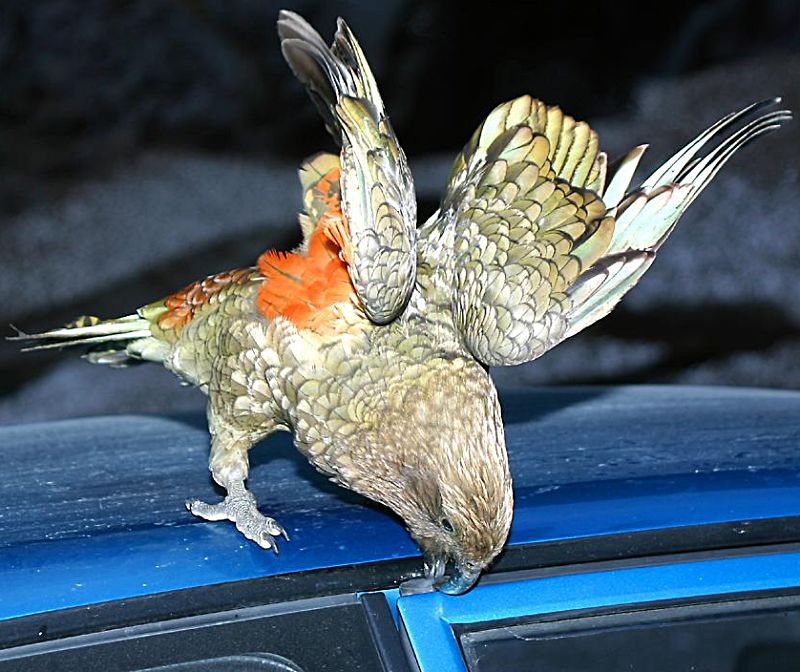
Peter Dunne (United Future Leader) refered to the deaths as "indigenous avian genocide", while ex-United Futre MP Larry Baldock, now leader of the Kiwi Party made the following comment in a press release,
"The Minister further confirmed her ignorance of the real dangers of 1080 when she stated that it broke down safely in water. The tests done to confirm that were carried out with water at 21 degrees C. Perhaps she could please advise which of NZ rivers are flowing at that nice warm toasty temperature so we can all go and have a hot swim completely safe from 1080 poisoning, said Mr Baldock."
However, the Department of Conservation website states that "1080 operations are usually conducted in winter and spring when wetter conditions assist rapid breakdown.", and also "1080 baits are dyed green and flavoured with cinnamon to make them less attractive to birds. Individual birds may be poisoned but these numbers are exceedingly low."
The death of seven Keas and one Takahē is nothing compared to the much higher threat to native birds from such pests as possums and ferrets, which the pesticide is so effective against. Instead of a typical knee-jerk reaction, banning 1080, why don't we instead do some research into how it can be used with minimum adverse effect to our native and endangered wild-life?
But what about the farmers? Is anyone standing up for the hard-working farmers who form the backbone of New Zealand's economy? Or are we so blinded by our desire to not let a few little birdies be accidentaly killed, that we will ban the pesticide which is currently the cheapest and most effective on the market?
"Another season of low wool prices means escalating pest control costs will take their toll on farming families. The financial limitations mean that a cheaper alternative to large-scale aerial 1080 poisoning is needed if farming operations are to remain viable at today’s commodity prices."
- from the Ministry of Agriculture and Forestry website
It would bother me far less that a handful of birds were killed by 1080, than that a farming family had to sell up due to yet one more unrealistic and unfair regulation imposed upon them. And why can't our members of Parliament spend their time discussing important issues, not aruging out of their lack of experience, on subjects that they do not understand.
Sunday, 20 July 2008
Marketing Bill Passed into Law (satire)
The Unthinkable has happened. Parliament has passed the Marketing Bill into Law. The Marketing Bill, as most of you will be aware, exists to create what the bill's sponsor Labour MP Annette King terms "an even playing field". What she means by this is that the amount of money that a business can spend on marketing per year should be restricted. Further, any individual wishing to promote a company which they have found useful, must first register with the Marketing Commission to be allowed to do this. And even then, the amount of time that they may spend promoting a company to friends and family will be restricted to 120 minutes per year. Below I have the transcript of Annette King's introduction in the third reading of the bill.
To read the full speech, please click here.
The bill passed, with
Ayes 63 New Zealand Labour 49; New Zealand First 7; Green Party 6; Progressive 1.
Noes 57 New Zealand National 48; Māori Party 4; United Future 2; ACT New Zealand 2; Independent: Field (Gordon Copeland absent).
Annette King - 18 December, 2007
Third Reading of the Marketing Finance Bill
"I move that the Marketing Finance Bill be now read a third time.
This Bill has been a contentious one, its passage marked by acrimonious debate and a campaign of misinformation. A major newspaper, the New Zealand Herald, devoted almost a month to attacking the Bill and the Government in a campaign the like of which has not been seen since a Labour Government legislated to stop tobacco advertising. One can’t help but wonder if the motives for the current campaign are not very similar to the last one.
Much has been said and written about the Bill. In yesterday’s Dom Post a letter to the editor summed it up for many people: Business is not “one dollar, one sale”.
An article in last week’s Otago Daily Times made some relevant points. I quote: “As much as we like to imagine that freedom of advertising is an absolute, it isn’t. There are several laws that proscribe it.” The article went on to say that a leading opponent of the Bill believed an ideal business environment would let money be free to talk whenever, and however loud, it likes. The truth was, the article said, that this man “has bags of money and no hesitation in using any amount of it to try to influence the purchasing decisions of the consumer.”
This Bill demonstrates the Government’s commitment to ensure that wealthy business-owners do not have more advertising power than small-players. The Commerce Select Committee, the Government, and Parliament during committee stages have listened to concerns about the Marketing Finance Bill, and have not made any changes that improve the Bill.
Madam Speaker, this Bill is about creating a fair, transparent business environment that puts all businesses on a level playing field with clearly defined rules and safeguards to protect the small-players from being drowned out due to the higher marketing budgets of larger companies. We do not want to see the Americanisation of our market.
This Bill does not restrict freedom of marketing. It simply restricts rights to ‘purchase’ sales through advertising. This is being done to safeguard our market by keeping to a minimum the undue influence of money in marketing. That’s what a level playing field means, and the Government believes most New Zealanders understand and support this principle.
The Bill makes changes that will help to bring New Zealand into line with other comparable democracies, such as Russia under the rule of Stalin, and Zimbabwe under the rule of Mugabe. These reforms are important, as fair and transparent advertising-campaigns are fundamental to our market...
...Madam Speaker, this Bill does not restrict freedom of advertising. It simply restricts rights to ‘purchase’ sales through advertising. This is being done to safeguard our market by keeping to a minimum the undue influence of money in advertising.
If we want to protect the ability of all New Zealanders to participate in, and grow the economy, we must ensure that businesses with limited resources can realistically compete with those with deep pockets, by restricting how much individual businesses may spend on advertising their goods or services.
I commend this Bill to the House."
To read the full speech, please click here.
The bill passed, with
Ayes 63 New Zealand Labour 49; New Zealand First 7; Green Party 6; Progressive 1.
Noes 57 New Zealand National 48; Māori Party 4; United Future 2; ACT New Zealand 2; Independent: Field (Gordon Copeland absent).
Tuesday, 4 December 2007
mention in the house
On Wednesday 21 November, I was in Wellington for the day, to attend the protest march against the Electoral Finance Bill . Also on the agenda, was collecting signatures for the petition for a referendum on the Anti-Smacking law, and to touch base with some team-members of the "feet on footpaths" group, Unity for Liberty. The next day, the bill passed it's second reading, 65 for, 54 against.
Following the march, I was looking forward to going up to the gallery for an hour or two, to observe the house in session. The security guards at the metal-detector turned me away saying that I was not allowed in due to having taken part in a protest march. I rang Larry Baldock and he gave Gordon Copeland, co-leader of the new Future New Zealand party a call. Thanks to Simeon Brown of nzdebate.blogspot.com for bringing this excerpt of Hansard to my attention.
Thursday 22 November 07 - Points of Order - Parliament Buildings - Public Access
GORDON COPELAND (Independent): I raise a point of order, Madam Speaker. On returning to my office yesterday immediately after question time, I discovered that a young man from Christchurch, who is known to me, had been in touch to say that he had been denied access to the parliamentary complex and therefore to the gallery to observe question time. Security had intervened to prevent his entering the parliamentary complex, on the basis that he had participated in yesterday's march in opposition to the Electoral Finance Bill, and because of a ruling from your office, which stipulates that people in that situation are denied entry to the parliamentary complex for 24 hours. I was able to vouch for the young man so that following contact with your office he was eventually admitted to Parliament Buildings and to the gallery late in the afternoon.
However, I found through this incident yesterday that I would like to ask you to reconsider your ruling in regard to that matter—or the ruling of your office, because I am not sure whether it is your ruling or one by one of the former Speakers of the House. I want to suggest to you some reasons why the reconsideration should happen. Firstly, the security arrangements for Parliament Buildings are now far more stringent than was the case, say, 12 months ago. Secondly, I think the application of the ruling is very arbitrary. I had to ask that young man how parliamentary security knew he had been in yesterday's march. He said that he guessed they must have recognised him. You will appreciate that there are sometimes hundreds—if not thousands—of people on such marches. Therefore, a blanket ban of that sort must always be arbitrary in its application. Thirdly, I hold the view that, subject to normal security checks, etc., access to Parliament Buildings should be the right of all New Zealand citizens as part of the fundamental freedom that is a cornerstone of our democracy.
Madam SPEAKER: I would just note that this is a matter that I am prepared to look at. It is not normally a matter for this Chamber. It is not appropriate to bring it up here, but I can indicate that, yes, I am happy to look at the matter, and to get back to both members.
KEITH LOCKE (Green): Madam Speaker, you will remember that I sent you a note on this issue months ago. There is a problem, I think—
Madam SPEAKER: As I indicated to the member, we are taking time from the House at the moment. I have already indicated I am happy to look at the issue. If any other member would like to make a representation on it to me in writing, would he or she please do so, so it can be thoroughly looked at.
Thursday, 22 March 2007
National: ahead of Labour in the Roy Morgan poll
The latest Roy Morgan Research poll shows National has lost ground although it is still well ahead of Labour.
The poll of 899 voters puts National on 45 per cent support, down 3.5 points on the previous Roy Morgan poll, with Labour unchanged on 36 per cent.
The Green Party was unchanged on 8.5 per cent, ACT was up 1.5 points to 2.5 per cent, The Maori Party was up 2 points to 3.5 per cent, New Zealand First was down 1 point to 2 per cent, and United Future was unchanged on 1.5 per cent.
The poll was conducted between February 19 and March 4.
The previous poll was conducted between February 6 and February 18.
The latest poll had a margin of error of plus or minus 3.2 per cent.
Subscribe to:
Posts (Atom)